

back
Designed a Talent Acquisition Ecosystem
Product discovery, System Thinking, Research, IA, User Persona, Validation and Cross Functional Collaboration
Overview

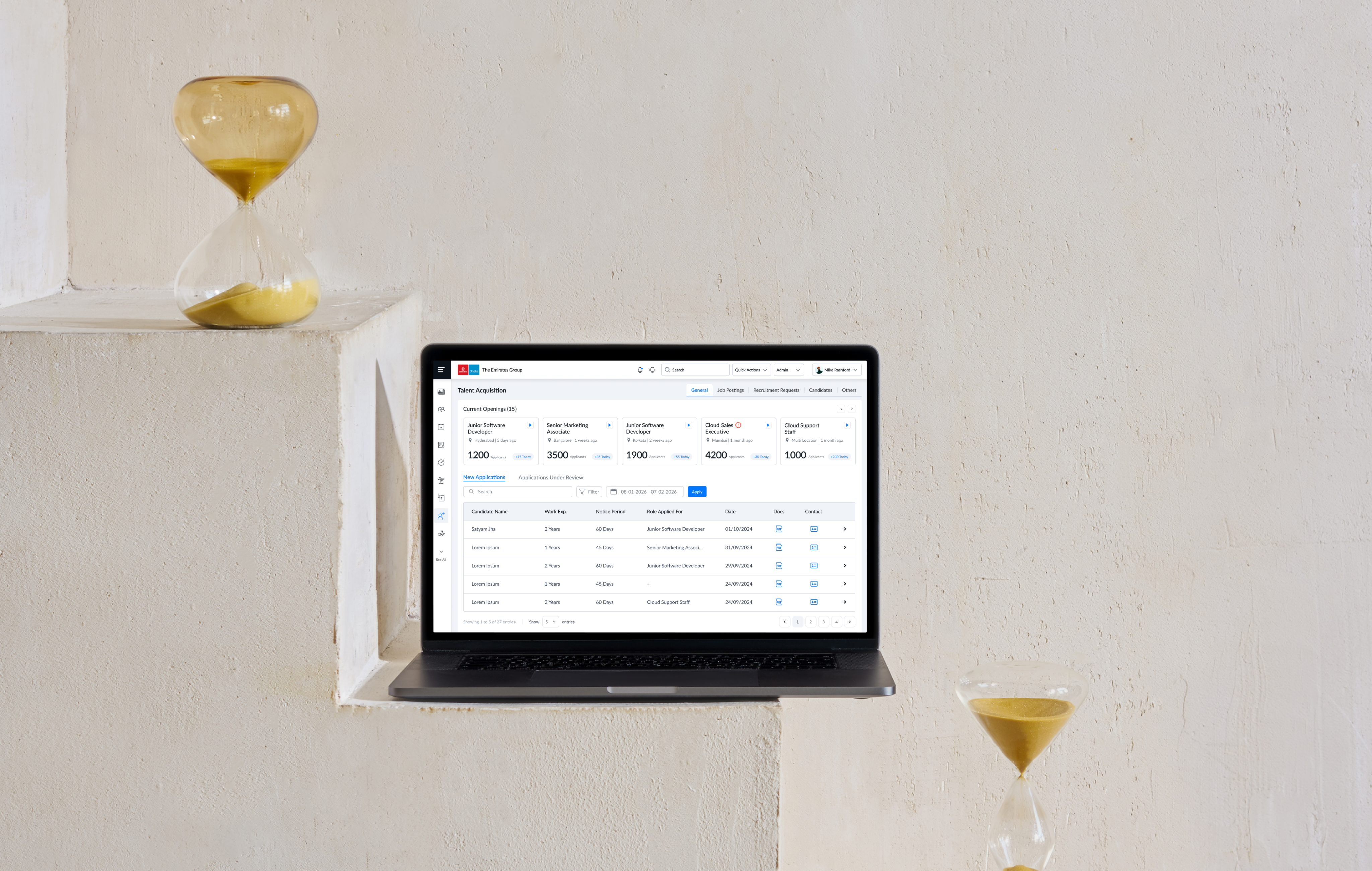
This was not a feature design exercise. It was a systems thinking challenge. What began as adding a Talent Acquisition module quickly expanded into building a connected hiring ecosystem inside our HRMS, spanning recruiter workflows, candidate experiences, onboarding automation, and employee creation. Designing this required navigating ambiguous requirements, evolving scope, technical constraints, and deeply interconnected product workflows.
The Challenge

The initial business objective was clear: HR teams needed to manage hiring directly inside the HRMS instead of relying on disconnected external systems.
But the actual design challenge was much bigger.
Modern recruitment products are fragmented by nature. Some optimize for applicant tracking, some for collaboration, some for enterprise workflows, and some for candidate experience. There was no obvious “best practice” blueprint to lift and replicate. On top of that, our long-term vision required recruitment to connect directly into employee onboarding, document verification, and HR records creation without manual duplication.
Diagnosis Before Design

I started with competitive analysis across talent acquisition and HR platforms including Keka, Workday, and several recruitment/job platforms to understand workflow patterns, feature models, and UX conventions.
What became clear early was that there was no universal model.
Each platform optimized for different assumptions, user maturity levels, and business priorities. Rather than copy an existing model, the more practical approach was to define a workflow tailored to our users, product architecture, and operational realities.
To ground this beyond market patterns, I spoke directly with HR professionals to understand their real hiring workflows, frustrations, expectations, and workarounds.
A few patterns emerged:
- Hiring workflows often involved repeated manual data entry
- Candidate handoff into onboarding was fragmented
- Coordination between hiring stakeholders lacked visibility
- Existing tools introduced operational friction rather than reducing it
Synthesizing The Discoveries

This phase was intentionally messy.
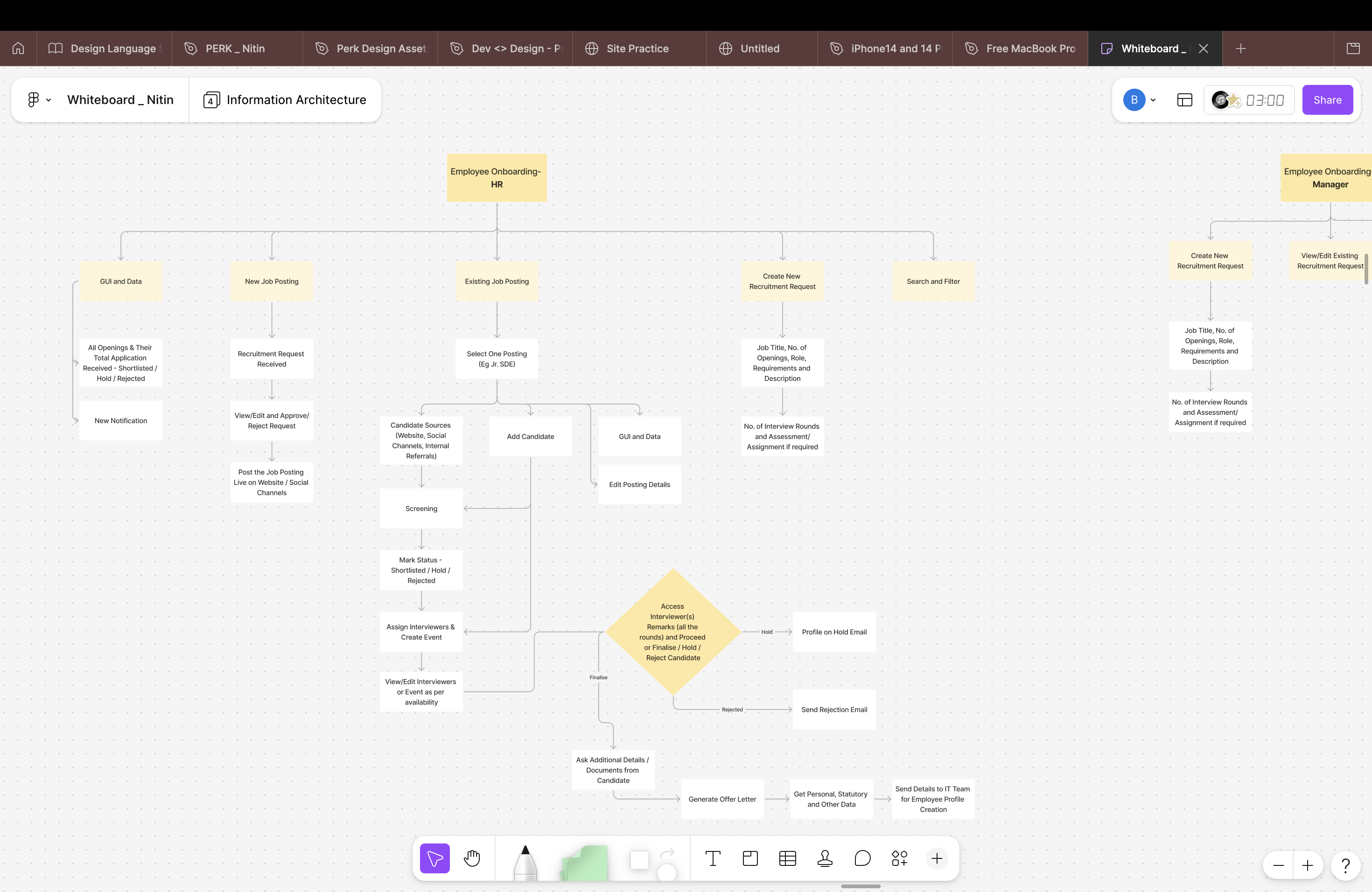
I translated research into user personas, journey maps, whiteboard workflows, information architecture explorations, and candidate lifecycle models. Because the problem space was interconnected, this was not a linear UX process.
Even after wireframing, I frequently returned to the whiteboard to rethink assumptions, simplify flows, and optimize transitions between hiring stages.
The goal is not to build a recruitment module. The goal is to reduce operational friction across the entire hiring-to-onboarding lifecycle. That shift changed everything.
Designing the System - Internal Hiring Workspace

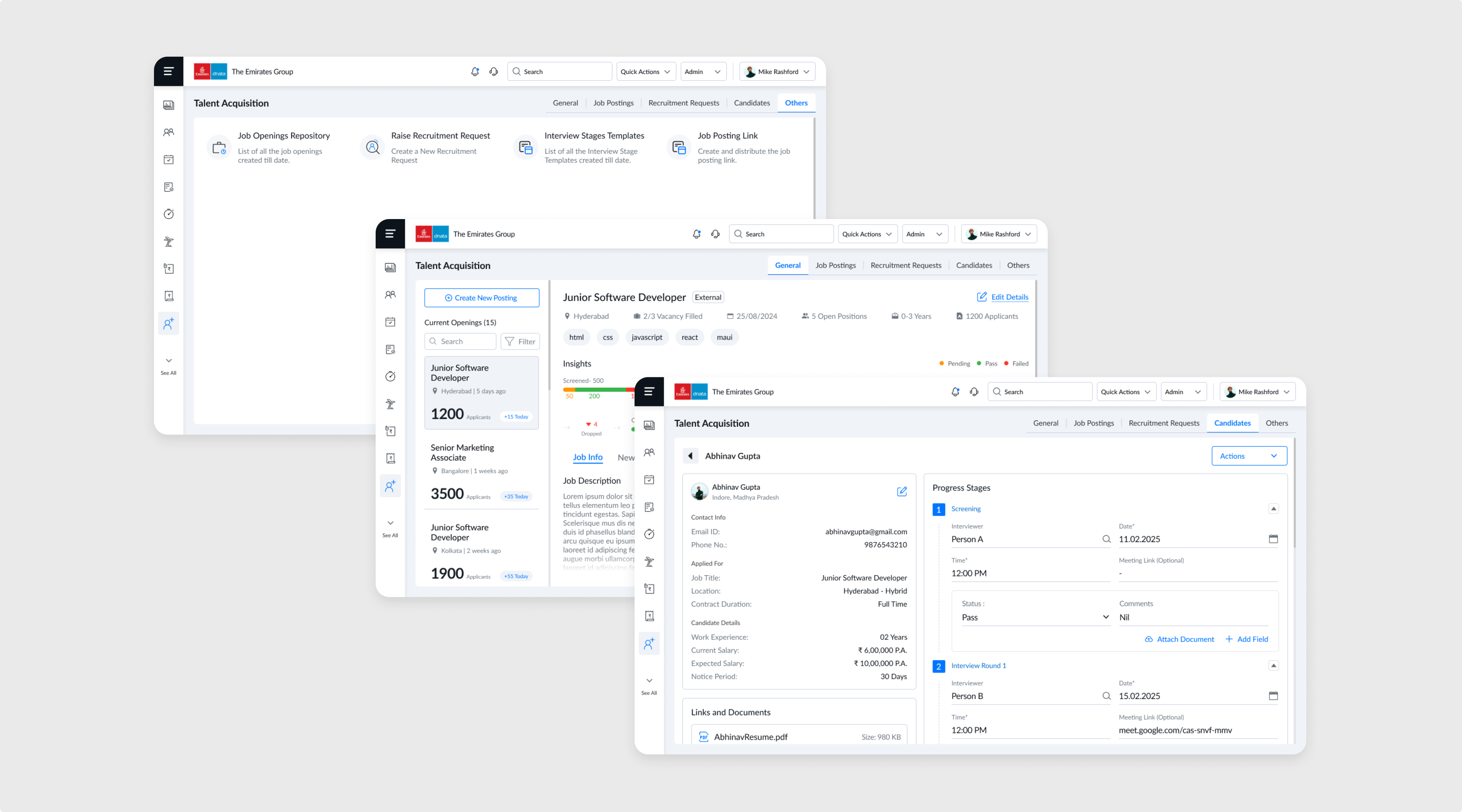
The solution was structured around two connected ecosystems. A role-based hiring system for HR teams to:
- create and manage job openings
- track applicants across hiring stages
- schedule interviews
- manage candidate evaluation
- coordinate hiring decisions
- generate and manage offer workflows
This focused on operational efficiency and workflow visibility.
Designing the System - Candidate Experience Portal

Midway through the project, the scope evolved significantly.
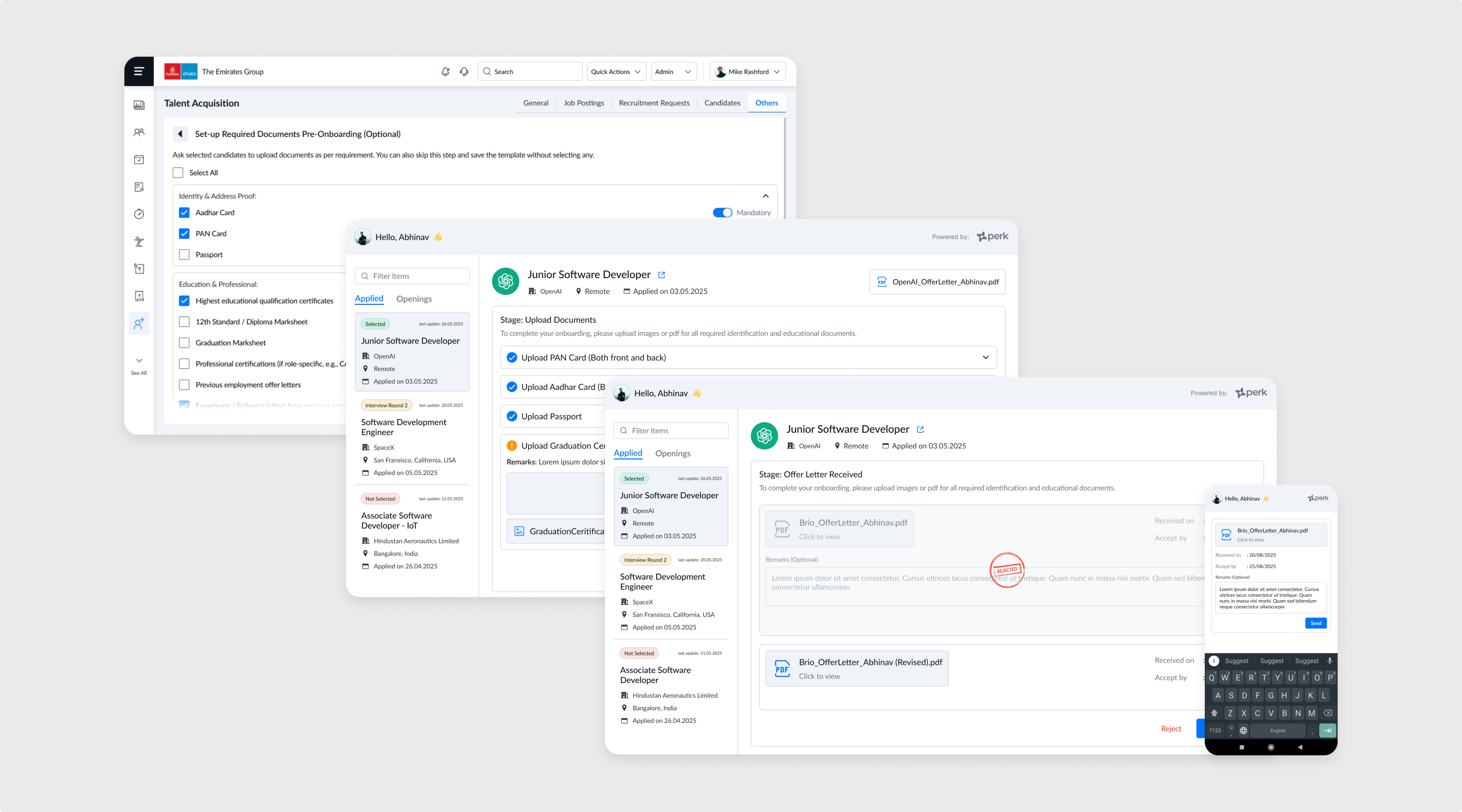
The module was no longer just for internal HR operations. We also needed a dedicated candidate-facing experience where applicants could:
- create and manage their profiles
- track application progress
- receive offer communication
- upload verification documents
- complete onboarding requirements
This fundamentally changed the product architecture.
Instead of extending the existing system incrementally, I revisited the underlying journeys and redesigned the ecosystem to support both internal and external users cohesively.
Misjudgments and Course Corrections

The original assumption was a relatively contained talent acquisition workflow for HR users. Once the candidate-facing portal became part of the scope, the complexity multiplied significantly.
Instead of patching new requirements onto the existing structure, I stepped back, re-evaluated the journeys, and redesigned the system architecture more holistically.
That decision avoided creating fragmented experiences later.
Technical Constraints and Collaboration

This project required significantly deeper engineering collaboration than a typical UX flow.
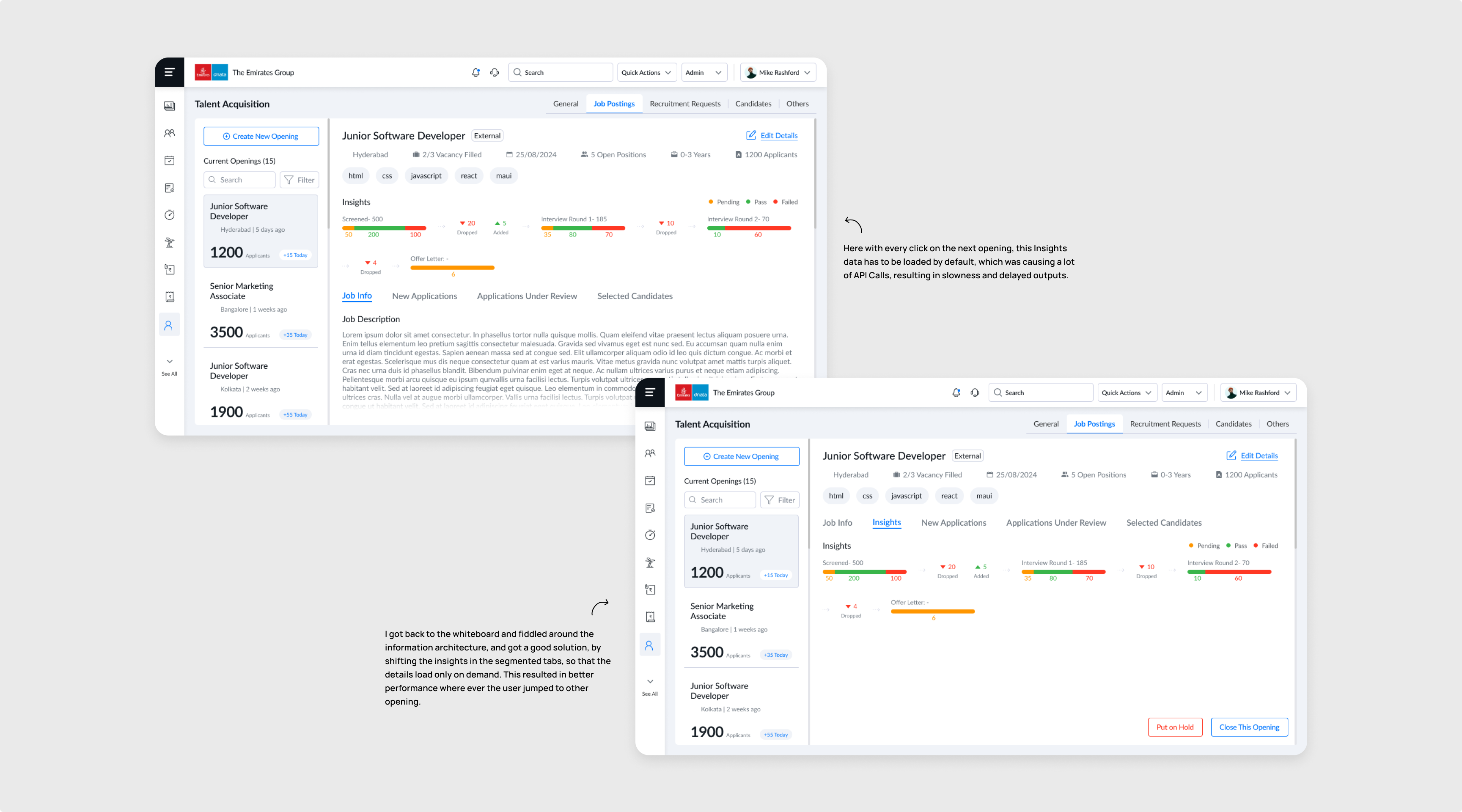
Certain workflows involved heavy API orchestration, state dependencies, and performance concerns. Some automation ideas looked promising from a UX perspective but became less practical once engineering complexity and product economics were considered.
We also explored more advanced intelligent automation concepts, but deprioritized some ideas after evaluating feasibility, cost, and long-term maintainability.
Rather than forcing idealized UX patterns, the solution evolved through practical trade-offs between user value, engineering constraints, and product viability.
Impact

Currently in closed beta, so measurable adoption metrics are still pending.
However, the delivered solution already creates meaningful product value:
- Expanded the HRMS from workforce management into talent acquisition
- Created a connected candidate-to-employee journey instead of fragmented workflows
- Reduced dependency on external recruitment tools
- Established scalable workflow architecture for future automation
- Improved operational efficiency by identifying manual touch points for elimination
What I Learnt

This project strengthened my ability to design within ambiguity.
I learned how to navigate evolving scope without losing structural clarity, how systems thinking becomes critical when workflows span multiple user roles and lifecycle stages, and how deeply product design is shaped by engineering realities.
It also reinforced that good product design is rarely about copying “best practices.” In complex domains, the better approach is understanding user workflows deeply, synthesizing constraints, and designing solutions that fit the actual ecosystem.
Open to new challenges, let’s connect.


Designed a Talent Acquisition Ecosystem
Product discovery, System Thinking, Research, IA, User Persona, Validation and Cross Functional Collaboration
Overview

This was not a feature design exercise. It was a systems thinking challenge. What began as adding a Talent Acquisition module quickly expanded into building a connected hiring ecosystem inside our HRMS, spanning recruiter workflows, candidate experiences, onboarding automation, and employee creation. Designing this required navigating ambiguous requirements, evolving scope, technical constraints, and deeply interconnected product workflows.
The Challenge

The initial business objective was clear: HR teams needed to manage hiring directly inside the HRMS instead of relying on disconnected external systems.
But the actual design challenge was much bigger.
Modern recruitment products are fragmented by nature. Some optimize for applicant tracking, some for collaboration, some for enterprise workflows, and some for candidate experience. There was no obvious “best practice” blueprint to lift and replicate. On top of that, our long-term vision required recruitment to connect directly into employee onboarding, document verification, and HR records creation without manual duplication.
Diagnosis Before Design

I started with competitive analysis across talent acquisition and HR platforms including Keka, Workday, and several recruitment/job platforms to understand workflow patterns, feature models, and UX conventions.
What became clear early was that there was no universal model.
Each platform optimized for different assumptions, user maturity levels, and business priorities. Rather than copy an existing model, the more practical approach was to define a workflow tailored to our users, product architecture, and operational realities.
To ground this beyond market patterns, I spoke directly with HR professionals to understand their real hiring workflows, frustrations, expectations, and workarounds.
A few patterns emerged:
Hiring workflows often involved repeated manual data entry
Candidate handoff into onboarding was fragmented
Coordination between hiring stakeholders lacked visibility
Existing tools introduced operational friction rather than reducing it
Synthesizing The Discoveries

This phase was intentionally messy.
I translated research into user personas, journey maps, whiteboard workflows, information architecture explorations, and candidate lifecycle models. Because the problem space was interconnected, this was not a linear UX process.
Even after wireframing, I frequently returned to the whiteboard to rethink assumptions, simplify flows, and optimize transitions between hiring stages.
The goal is not to build a recruitment module. The goal is to reduce operational friction across the entire hiring-to-onboarding lifecycle. That shift changed everything.
Designing the System - Internal Hiring Workspace

The solution was structured around two connected ecosystems. A role-based hiring system for HR teams to:
create and manage job openings
track applicants across hiring stages
schedule interviews
manage candidate evaluation
coordinate hiring decisions
generate and manage offer workflows
This focused on operational efficiency and workflow visibility.
Designing the System - Candidate Experience Portal

Midway through the project, the scope evolved significantly.
The module was no longer just for internal HR operations. We also needed a dedicated candidate-facing experience where applicants could:
create and manage their profiles
track application progress
receive offer communication
upload verification documents
complete onboarding requirements
This fundamentally changed the product architecture.
Instead of extending the existing system incrementally, I revisited the underlying journeys and redesigned the ecosystem to support both internal and external users cohesively.
Misjudgments and Course Corrections

The original assumption was a relatively contained talent acquisition workflow for HR users. Once the candidate-facing portal became part of the scope, the complexity multiplied significantly.
Instead of patching new requirements onto the existing structure, I stepped back, re-evaluated the journeys, and redesigned the system architecture more holistically.
That decision avoided creating fragmented experiences later.
Technical Constraints and Collaboration

This project required significantly deeper engineering collaboration than a typical UX flow.
Certain workflows involved heavy API orchestration, state dependencies, and performance concerns. Some automation ideas looked promising from a UX perspective but became less practical once engineering complexity and product economics were considered.
We also explored more advanced intelligent automation concepts, but deprioritized some ideas after evaluating feasibility, cost, and long-term maintainability.
Rather than forcing idealized UX patterns, the solution evolved through practical trade-offs between user value, engineering constraints, and product viability.
Impact

Currently in closed beta, so measurable adoption metrics are still pending.
However, the delivered solution already creates meaningful product value:
Expanded the HRMS from workforce management into talent acquisition
Created a connected candidate-to-employee journey instead of fragmented workflows
Reduced dependency on external recruitment tools
Established scalable workflow architecture for future automation
Improved operational efficiency by identifying manual touch points for elimination
What I Learnt

This project strengthened my ability to design within ambiguity.
I learned how to navigate evolving scope without losing structural clarity, how systems thinking becomes critical when workflows span multiple user roles and lifecycle stages, and how deeply product design is shaped by engineering realities.
It also reinforced that good product design is rarely about copying “best practices.” In complex domains, the better approach is understanding user workflows deeply, synthesizing constraints, and designing solutions that fit the actual ecosystem.
Open to new challenges, let’s connect.

Overview
Challenge
Diagnosis
Synthesizing
Design 1
Design 2
Misjudgments
Constraints
The Impact
What I Learnt

Designed a Talent Acquisition Ecosystem
Product discovery, System Thinking, Research, IA, User Persona, Validation and Cross Functional Collaboration
Overview

This was not a feature design exercise. It was a systems thinking challenge. What began as adding a Talent Acquisition module quickly expanded into building a connected hiring ecosystem inside our HRMS, spanning recruiter workflows, candidate experiences, onboarding automation, and employee creation. Designing this required navigating ambiguous requirements, evolving scope, technical constraints, and deeply interconnected product workflows.
The Challenge

The initial business objective was clear: HR teams needed to manage hiring directly inside the HRMS instead of relying on disconnected external systems.
But the actual design challenge was much bigger.
Modern recruitment products are fragmented by nature. Some optimize for applicant tracking, some for collaboration, some for enterprise workflows, and some for candidate experience. There was no obvious “best practice” blueprint to lift and replicate. On top of that, our long-term vision required recruitment to connect directly into employee onboarding, document verification, and HR records creation without manual duplication.
Diagnosis Before Design

I started with competitive analysis across talent acquisition and HR platforms including Keka, Workday, and several recruitment/job platforms to understand workflow patterns, feature models, and UX conventions.
What became clear early was that there was no universal model.
Each platform optimized for different assumptions, user maturity levels, and business priorities. Rather than copy an existing model, the more practical approach was to define a workflow tailored to our users, product architecture, and operational realities.
To ground this beyond market patterns, I spoke directly with HR professionals to understand their real hiring workflows, frustrations, expectations, and workarounds.
A few patterns emerged:
- Hiring workflows often involved repeated manual data entry
- Candidate handoff into onboarding was fragmented
- Coordination between hiring stakeholders lacked visibility
- Existing tools introduced operational friction rather than reducing it
Synthesizing The Discoveries

This phase was intentionally messy.
I translated research into user personas, journey maps, whiteboard workflows, information architecture explorations, and candidate lifecycle models. Because the problem space was interconnected, this was not a linear UX process.
Even after wireframing, I frequently returned to the whiteboard to rethink assumptions, simplify flows, and optimize transitions between hiring stages.
The goal is not to build a recruitment module. The goal is to reduce operational friction across the entire hiring-to-onboarding lifecycle. That shift changed everything.
Designing the System - Internal Hiring Workspace

The solution was structured around two connected ecosystems. A role-based hiring system for HR teams to:
- create and manage job openings
- track applicants across hiring stages
- schedule interviews
- manage candidate evaluation
- coordinate hiring decisions
- generate and manage offer workflows
This focused on operational efficiency and workflow visibility.
Designing the System - Candidate Experience Portal

Midway through the project, the scope evolved significantly.
The module was no longer just for internal HR operations. We also needed a dedicated candidate-facing experience where applicants could:
- create and manage their profiles
- track application progress
- receive offer communication
- upload verification documents
- complete onboarding requirements
This fundamentally changed the product architecture.
Instead of extending the existing system incrementally, I revisited the underlying journeys and redesigned the ecosystem to support both internal and external users cohesively.
Misjudgments and Course Corrections

The original assumption was a relatively contained talent acquisition workflow for HR users. Once the candidate-facing portal became part of the scope, the complexity multiplied significantly.
Instead of patching new requirements onto the existing structure, I stepped back, re-evaluated the journeys, and designed the system architecture more holistically.
That decision avoided creating fragmented experiences later.
Technical Constraints and Collaboration

This project required significantly deeper engineering collaboration than a typical UX flow.
Certain workflows involved heavy API orchestration, state dependencies, and performance concerns. Some automation ideas looked promising from a UX perspective but became less practical once engineering complexity and product economics were considered.
We also explored more advanced intelligent automation concepts, but deprioritized some ideas after evaluating feasibility, cost, and long-term maintainability.
Rather than forcing idealized UX patterns, the solution evolved through practical trade-offs between user value, engineering constraints, and product viability.
Impact

Currently in closed beta, so measurable adoption metrics are still pending.
However, the delivered solution already creates meaningful product value:
- Expanded the HRMS from workforce management into talent acquisition
- Created a connected candidate-to-employee journey instead of fragmented workflows
- Reduced dependency on external recruitment tools
- Established scalable workflow architecture for future automation
- Improved operational efficiency by identifying manual touch points for elimination
What I Learnt

This project strengthened my ability to design within ambiguity.
I learned how to navigate evolving scope without losing structural clarity, how systems thinking becomes critical when workflows span multiple user roles and lifecycle stages, and how deeply product design is shaped by engineering realities.
It also reinforced that good product design is rarely about copying “best practices.” In complex domains, the better approach is understanding user workflows deeply, synthesizing constraints, and designing solutions that fit the actual ecosystem.
Open to new challenges, let’s connect.


