

back
Reimagining Payroll Processing Through an Agentic Experience
Product discovery, UX strategy, AI workflow design, User Research, Information Architecture, Interaction Design, Prototyping
Overview

Payroll processing is one of the most critical workflows inside an HRMS. Every payroll cycle requires HR teams to gather attendance, reimbursements, taxes, deductions, previous salary adjustments, and multiple operational inputs before validating and processing salaries. The process is repetitive, highly manual, and leaves little room for error.
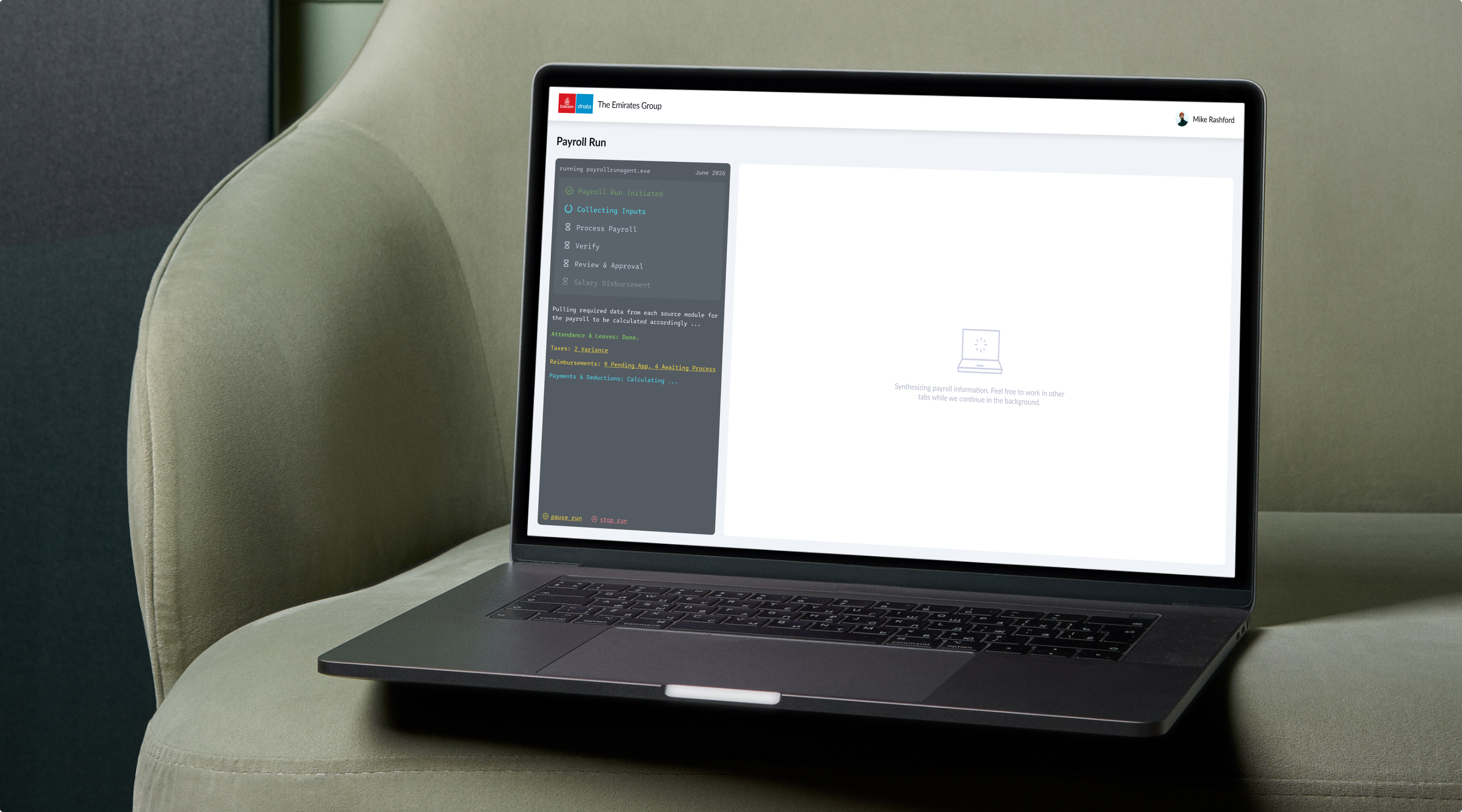
Rather than improving individual screens, I proposed an agentic payroll experience that could orchestrate the entire payroll lifecycle, automate repetitive tasks, surface only meaningful exceptions, and allow HR teams to focus on validation instead of administration.Experience the Prototype here.
The Opportunity

This project wasn't initiated as a product requirement. It began during an ideation session with our CTO, where we were discussing the growing operational overhead HR teams face during every payroll cycle.
The more we mapped the existing workflow, the clearer it became that HR professionals weren't spending most of their time making decisions. They were spending it collecting information, switching between modules, validating reports, and repeating operational tasks.
That observation led to a simple question.
What if payroll behaved less like a workflow and more like an intelligent system that orchestrates the entire process?
That question became the foundation of the project.
Understanding the Workflow

Before proposing automation, I wanted to understand how payroll actually happened.
I conducted multiple user interviews with HR professionals responsible for payroll processing, observing how they collected inputs, validated information, handled discrepancies, and managed exceptions.
One pattern became obvious. The process itself wasn't difficult. The operational overhead was.
HR teams continuously switched between attendance, reimbursements, statutory modules, payroll reports, and employee records before finally processing payroll. Most of the effort wasn't decision-making. It was collection of data and coordination.
Synthesis & Reframing

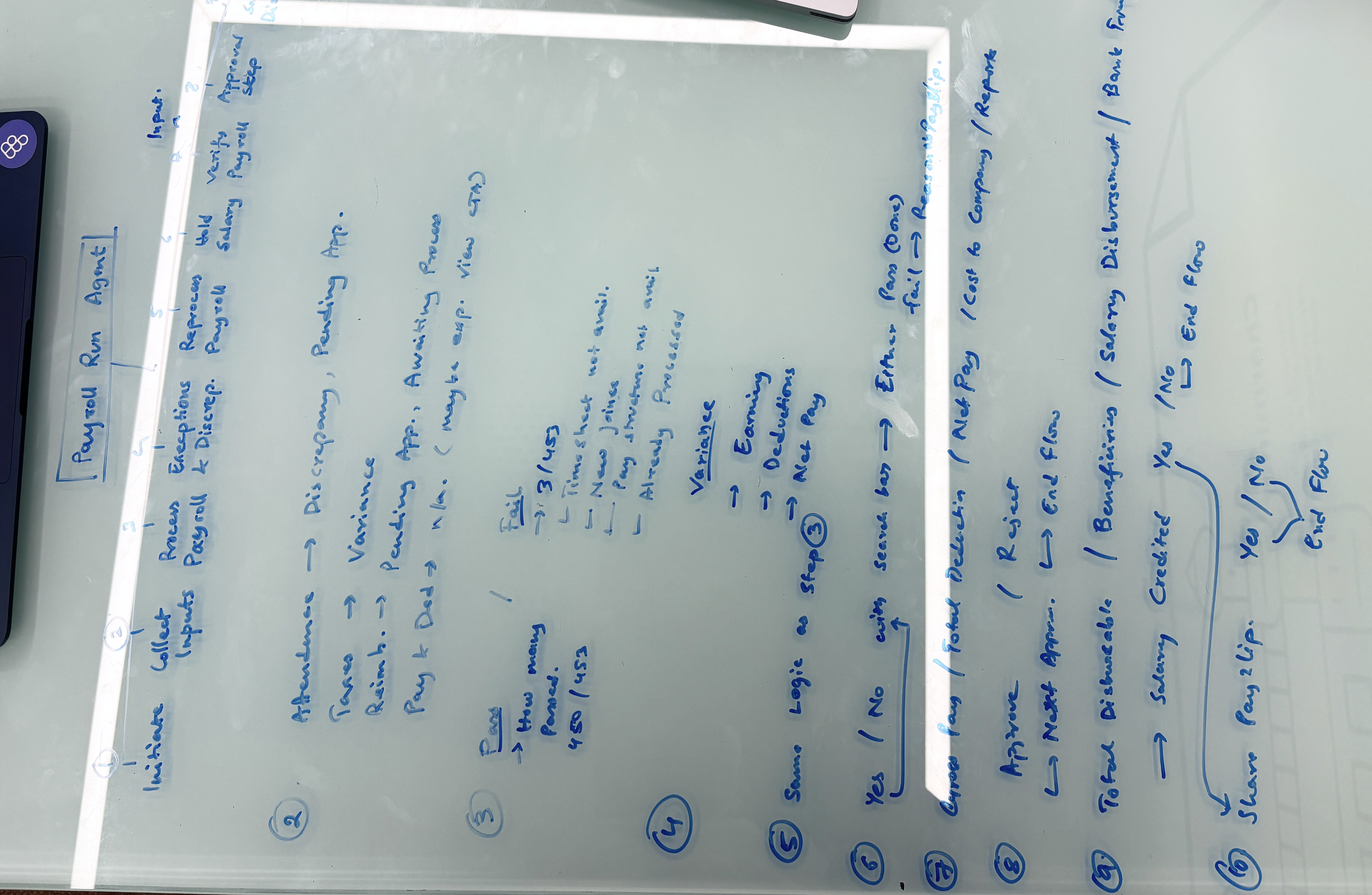
I translated research into workflow maps, mind maps, information architecture, and system-level flow diagrams.
Initially, I looked at payroll as a sequence of screens. As the research progressed, I realized payroll should instead be treated as an orchestration engine. Instead of asking:
"How should users complete payroll?"
The question became:
"How can the system complete payroll while involving users only when judgment is required?"
That shift fundamentally changed the direction of the product.
Designing the Agent

The experience was intentionally designed as an agentic workflow rather than a conversational chatbot.
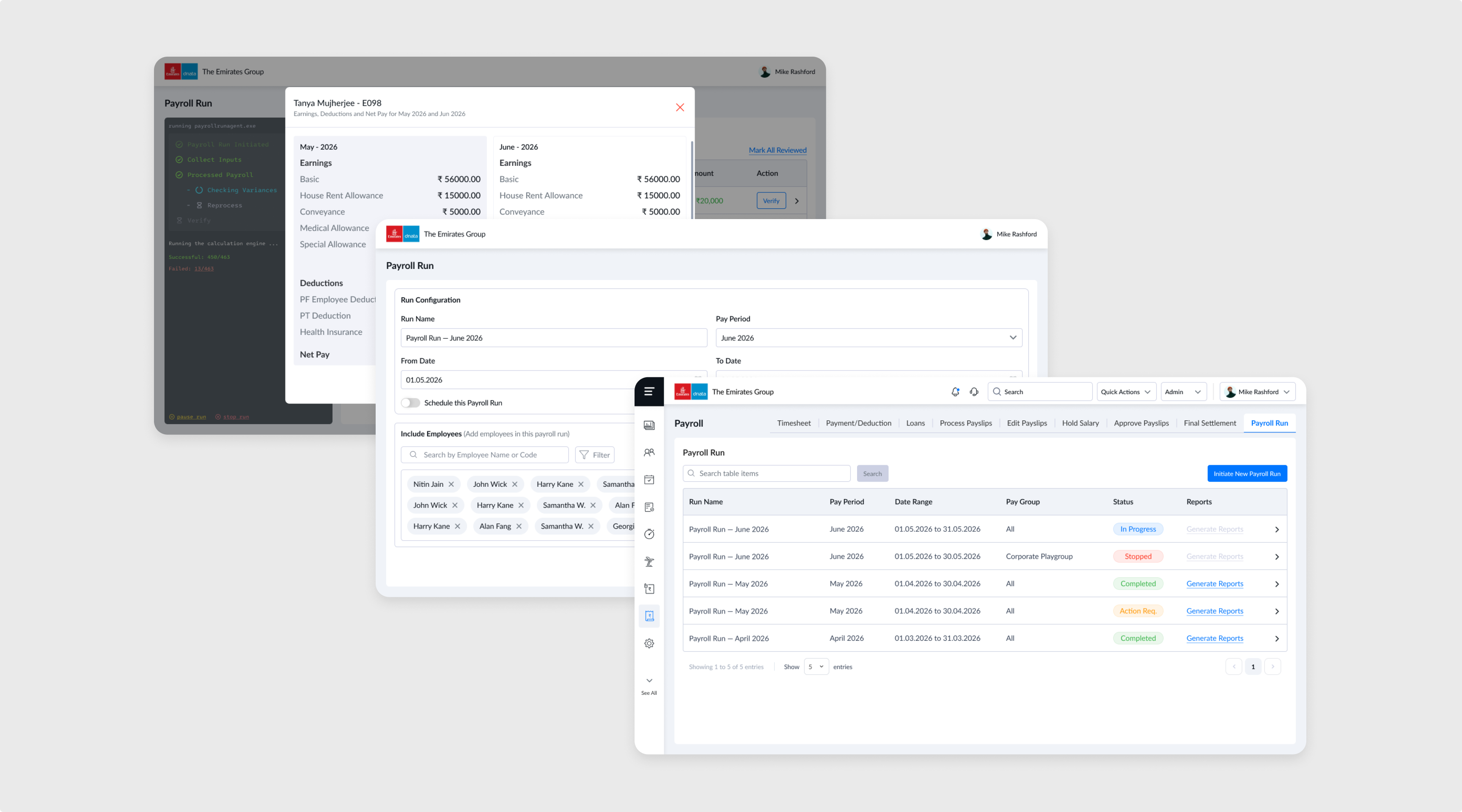
After HR provided the required payroll inputs, the system would automatically:
- collect data across relevant HRMS modules
- validate payroll inputs
- identify inconsistencies
- surface exceptions
- request approvals where necessary
- continue processing once issues were resolved
The objective was not replacing HR professionals. It was removing repetitive operational work while keeping them in control of critical business decisions.
Misjudgements & Course Corrections

One of the biggest lessons came from my own initial assumptions. My first concept gave the agent significantly more autonomy, allowing it to make decisions across several payroll scenarios automatically. During product discussions, our CTO challenged this direction.
Payroll is a sensitive business function where incorrect decisions can directly impact employees. That conversation helped me rethink the balance between automation and accountability.
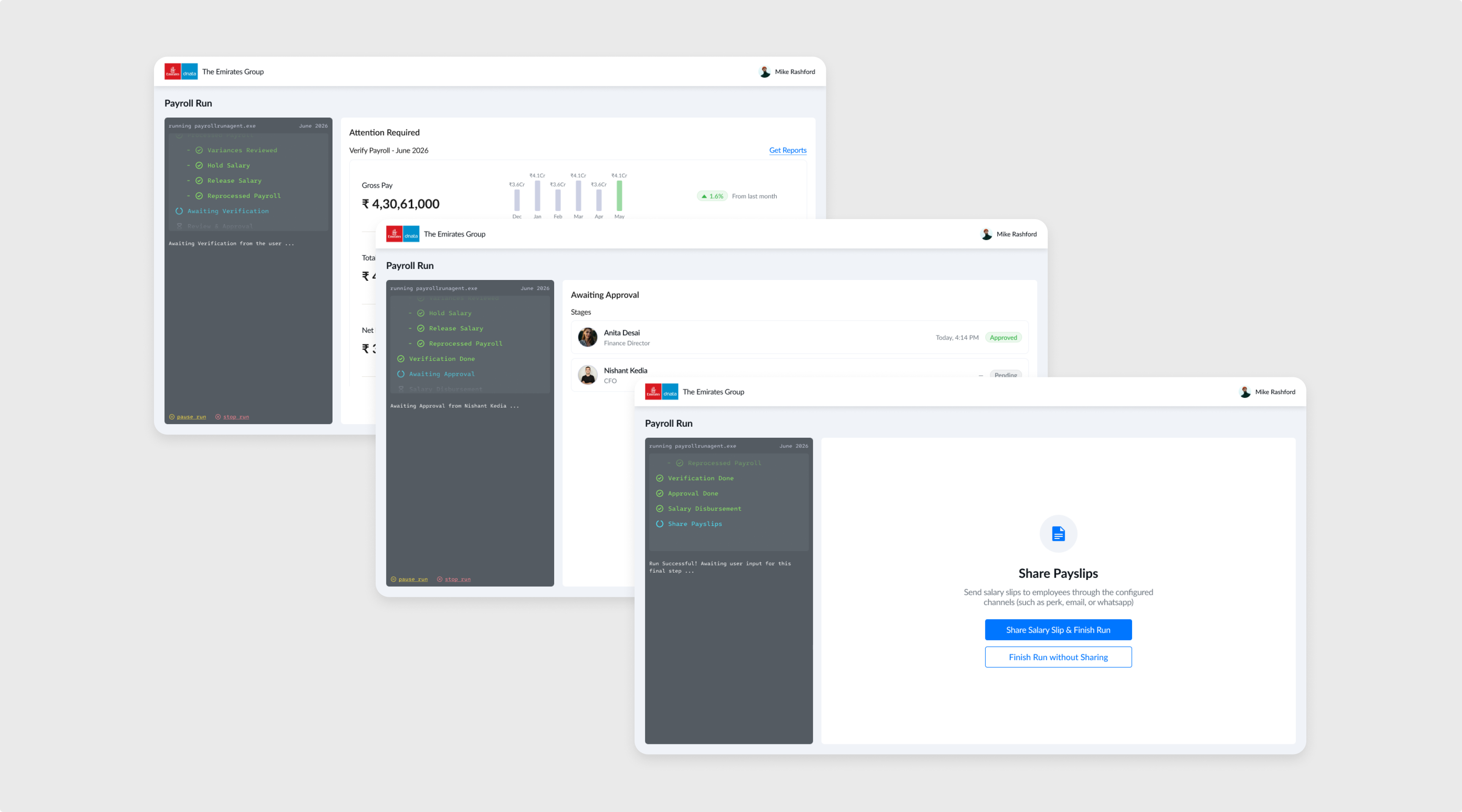
The final experience deliberately kept validation, approvals, and exception handling with HR users, allowing AI to automate execution while humans retained ownership of critical decisions.
Looking back, this became one of the most valuable decisions in the project.
Validation and Iteration

Beyond workflow automation, I wanted users to feel confident about what the system was doing. Instead of hiding background processes, I designed the experience around an execution panel inspired by terminal interfaces, allowing HR teams to observe the agent progressing through each payroll stage in real time.
This created transparency without requiring constant user intervention. I explored multiple interaction approaches through A/B testing before arriving at the final experience.
Prototypes were vibe coded using Clade and Figma Make alongside traditional wireframing to rapidly validate interaction concepts before moving toward implementation.
Collaboration

Because the experience introduced AI into one of the most sensitive workflows inside the product, close collaboration became essential.
I worked closely with HR team, the CTO, and engineering to balance automation, technical feasibility, operational trust, and implementation cost.
We also consciously avoided building an unnecessarily expensive Tokens and LLM heavy system. Instead, the solution combined deterministic automation with an agentic user experience, using AI where it created genuine value while minimizing token consumption and operational costs.
Expected Outcome

The product is currently under production and approaching its first release. Beyond introducing a new way of thinking about payroll inside our HRMS, the solution is expected to shift the experience from manual workflow execution to intelligent workflow orchestration.
Expected outcomes include:
- ~50% reduction in frontend development effort, enabled by AI-assisted prototyping and vibe-coded interactive prototypes.
- Strong usability validation, with the concept receiving positive feedback and broad acceptance during moderated usability testing.
- Significant reduction in manual payroll effort by automating repetitive validation and data orchestration across multiple HRMS modules.
- Faster payroll processing with fewer operational errors, allowing HR teams to focus on reviewing exceptions rather than manually coordinating every step.
- A scalable foundation for future AI-assisted workflows, establishing a human-in-the-loop approach that balances automation with trust and accountability.
What I Learnt
This project fundamentally changed how I think about AI in enterprise products. I learned that the goal isn't to automate everything. The goal is to automate the predictable and preserve human judgment where trust, accountability, and business risk matter most.
It also strengthened my understanding of designing agentic experiences that feel transparent rather than magical, where users always understand what the system is doing and why.
Open to new challenges, let’s connect.


Reimagining Payroll Processing Through an Agentic Experience
Product discovery, UX strategy, AI workflow design, User Research, Information Architecture, Interaction Design, Prototyping
Overview

Payroll processing is one of the most critical workflows inside an HRMS. Every payroll cycle requires HR teams to gather attendance, reimbursements, taxes, deductions, previous salary adjustments, and multiple operational inputs before validating and processing salaries. The process is repetitive, highly manual, and leaves little room for error.
Rather than improving individual screens, I proposed an agentic payroll experience that could orchestrate the entire payroll lifecycle, automate repetitive tasks, surface only meaningful exceptions, and allow HR teams to focus on validation instead of administration.Experience the Prototype here.
The Opportunity

This project wasn't initiated as a product requirement. It began during an ideation session with our CTO, where we were discussing the growing operational overhead HR teams face during every payroll cycle.
The more we mapped the existing workflow, the clearer it became that HR professionals weren't spending most of their time making decisions. They were spending it collecting information, switching between modules, validating reports, and repeating operational tasks.
That observation led to a simple question.
What if payroll behaved less like a workflow and more like an intelligent system that orchestrates the entire process?
That question became the foundation of the project.
Understanding the Workflow

Before proposing automation, I wanted to understand how payroll actually happened.
I conducted multiple user interviews with HR professionals responsible for payroll processing, observing how they collected inputs, validated information, handled discrepancies, and managed exceptions.
One pattern became obvious. The process itself wasn't difficult. The operational overhead was.
HR teams continuously switched between attendance, reimbursements, statutory modules, payroll reports, and employee records before finally processing payroll. Most of the effort wasn't decision-making. It was collection of data and coordination.
Synthesis & Reframing

I translated research into workflow maps, mind maps, information architecture, and system-level flow diagrams.
Initially, I looked at payroll as a sequence of screens. As the research progressed, I realized payroll should instead be treated as an orchestration engine. Instead of asking:
"How should users complete payroll?"
The question became:
"How can the system complete payroll while involving users only when judgment is required?"
That shift fundamentally changed the direction of the product.
Designing the Agent

The experience was intentionally designed as an agentic workflow rather than a conversational chatbot.
After HR provided the required payroll inputs, the system would automatically:
- collect data across relevant HRMS modules
- validate payroll inputs
- identify inconsistencies
- surface exceptions
- request approvals where necessary
- continue processing once issues were resolved
The objective was not replacing HR professionals. It was removing repetitive operational work while keeping them in control of critical business decisions.
Misjudgements & Course Corrections

One of the biggest lessons came from my own initial assumptions. My first concept gave the agent significantly more autonomy, allowing it to make decisions across several payroll scenarios automatically. During product discussions, our CTO challenged this direction.
Payroll is a sensitive business function where incorrect decisions can directly impact employees. That conversation helped me rethink the balance between automation and accountability.
The final experience deliberately kept validation, approvals, and exception handling with HR users, allowing AI to automate execution while humans retained ownership of critical decisions.
Looking back, this became one of the most valuable decisions in the project.
Validation and Iteration

Beyond workflow automation, I wanted users to feel confident about what the system was doing. Instead of hiding background processes, I designed the experience around an execution panel inspired by terminal interfaces, allowing HR teams to observe the agent progressing through each payroll stage in real time.
This created transparency without requiring constant user intervention. I explored multiple interaction approaches through A/B testing before arriving at the final experience.
Prototypes were vibe coded using Clade and Figma Make alongside traditional wireframing to rapidly validate interaction concepts before moving toward implementation.
Collaboration

Because the experience introduced AI into one of the most sensitive workflows inside the product, close collaboration became essential.
I worked closely with HR team, the CTO, and engineering to balance automation, technical feasibility, operational trust, and implementation cost.
We also consciously avoided building an unnecessarily expensive Tokens and LLM heavy system. Instead, the solution combined deterministic automation with an agentic user experience, using AI where it created genuine value while minimizing token consumption and operational costs.
Expected Outcome

The product is currently under production and approaching its first release. Beyond introducing a new way of thinking about payroll inside our HRMS, the solution is expected to shift the experience from manual workflow execution to intelligent workflow orchestration.
Expected outcomes include:
- ~50% reduction in frontend development effort, enabled by AI-assisted prototyping and vibe-coded interactive prototypes.
- Strong usability validation, with the concept receiving positive feedback and broad acceptance during moderated usability testing.
- Significant reduction in manual payroll effort by automating repetitive validation and data orchestration across multiple HRMS modules.
- Faster payroll processing with fewer operational errors, allowing HR teams to focus on reviewing exceptions rather than manually coordinating every step.
- A scalable foundation for future AI-assisted workflows, establishing a human-in-the-loop approach that balances automation with trust and accountability.
What I Learnt
This project fundamentally changed how I think about AI in enterprise products. I learned that the goal isn't to automate everything. The goal is to automate the predictable and preserve human judgment where trust, accountability, and business risk matter most.
It also strengthened my understanding of designing agentic experiences that feel transparent rather than magical, where users always understand what the system is doing and why.
Open to new challenges, let’s connect.

Overview
Opportunity
Research
Reframing
Design
Misjudgment
Validation
Collaboration
Outcome
What I Learnt

Reimagining Payroll Processing Through an Agentic Experience
Product discovery, UX strategy, AI workflow design, User Research, Information Architecture, Interaction Design, Prototyping
Overview

Payroll processing is one of the most critical workflows inside an HRMS. Every payroll cycle requires HR teams to gather attendance, reimbursements, taxes, deductions, previous salary adjustments, and multiple operational inputs before validating and processing salaries. The process is repetitive, highly manual, and leaves little room for error.
Rather than improving individual screens, I proposed an agentic payroll experience that could orchestrate the entire payroll lifecycle, automate repetitive tasks, surface only meaningful exceptions, and allow HR teams to focus on validation instead of administration.Experience the Prototype here.
The Opportunity

This project wasn't initiated as a product requirement. It began during an ideation session with our CTO, where we were discussing the growing operational overhead HR teams face during every payroll cycle.
The more we mapped the existing workflow, the clearer it became that HR professionals weren't spending most of their time making decisions. They were spending it collecting information, switching between modules, validating reports, and repeating operational tasks.
That observation led to a simple question.
What if payroll behaved less like a workflow and more like an intelligent system that orchestrates the entire process?
That question became the foundation of the project.
Understanding the Workflow

Before proposing automation, I wanted to understand how payroll actually happened.
I conducted multiple user interviews with HR professionals responsible for payroll processing, observing how they collected inputs, validated information, handled discrepancies, and managed exceptions.
One pattern became obvious. The process itself wasn't difficult. The operational overhead was.
HR teams continuously switched between attendance, reimbursements, statutory modules, payroll reports, and employee records before finally processing payroll. Most of the effort wasn't decision-making. It was collection of data and coordination.
Synthesis & Reframing

I translated research into workflow maps, mind maps, information architecture, and system-level flow diagrams.
Initially, I looked at payroll as a sequence of screens. As the research progressed, I realized payroll should instead be treated as an orchestration engine. Instead of asking:
"How should users complete payroll?"
The question became:
"How can the system complete payroll while involving users only when judgment is required?"
That shift fundamentally changed the direction of the product.
Designing the Agent

The experience was intentionally designed as an agentic workflow rather than a conversational chatbot.
After HR provided the required payroll inputs, the system would automatically:
- collect data across relevant HRMS modules
- validate payroll inputs
- identify inconsistencies
- surface exceptions
- request approvals where necessary
- continue processing once issues were resolved
The objective was not replacing HR professionals. It was removing repetitive operational work while keeping them in control of critical business decisions.
Misjudgements & Course Corrections

One of the biggest lessons came from my own initial assumptions. My first concept gave the agent significantly more autonomy, allowing it to make decisions across several payroll scenarios automatically. During product discussions, our CTO challenged this direction.
Payroll is a sensitive business function where incorrect decisions can directly impact employees. That conversation helped me rethink the balance between automation and accountability.
The final experience deliberately kept validation, approvals, and exception handling with HR users, allowing AI to automate execution while humans retained ownership of critical decisions.
Looking back, this became one of the most valuable decisions in the project.
Validation and Iteration

Beyond workflow automation, I wanted users to feel confident about what the system was doing. Instead of hiding background processes, I designed the experience around an execution panel inspired by terminal interfaces, allowing HR teams to observe the agent progressing through each payroll stage in real time.
This created transparency without requiring constant user intervention. I explored multiple interaction approaches through A/B testing before arriving at the final experience.
Prototypes were vibe coded using Clade and Figma Make alongside traditional wireframing to rapidly validate interaction concepts before moving toward implementation.
Collaboration

Because the experience introduced AI into one of the most sensitive workflows inside the product, close collaboration became essential.
I worked closely with HR team, the CTO, and engineering to balance automation, technical feasibility, operational trust, and implementation cost.
We also consciously avoided building an unnecessarily expensive Tokens and LLM heavy system. Instead, the solution combined deterministic automation with an agentic user experience, using AI where it created genuine value while minimizing token consumption and operational costs.
Expected Outcome

The product is currently under production and approaching its first release. Beyond introducing a new way of thinking about payroll inside our HRMS, the solution is expected to shift the experience from manual workflow execution to intelligent workflow orchestration.
Expected outcomes include:
- ~50% reduction in frontend development effort, enabled by AI-assisted prototyping and vibe-coded interactive prototypes.
- Strong usability validation, with the concept receiving positive feedback and broad acceptance during moderated usability testing.
- Significant reduction in manual payroll effort by automating repetitive validation and data orchestration across multiple HRMS modules.
- Faster payroll processing with fewer operational errors, allowing HR teams to focus on reviewing exceptions rather than manually coordinating every step.
- A scalable foundation for future AI-assisted workflows, establishing a human-in-the-loop approach that balances automation with trust and accountability.
What I Learnt
This project fundamentally changed how I think about AI in enterprise products. I learned that the goal isn't to automate everything. The goal is to automate the predictable and preserve human judgment where trust, accountability, and business risk matter most.
It also strengthened my understanding of designing agentic experiences that feel transparent rather than magical, where users always understand what the system is doing and why.
Open to new challenges, let’s connect.


